The Foundation Layer: Understanding What Mentorship Actually Is
After two decades of building distributed systems and watching countless engineers grow from junior contributors to technical leaders, I’ve learned that most discussions about mentorship miss the fundamental point. Mentorship isn’t about giving advice or sharing war stories over coffee. It’s about creating a structured learning environment where knowledge transfer happens systematically, not accidentally.
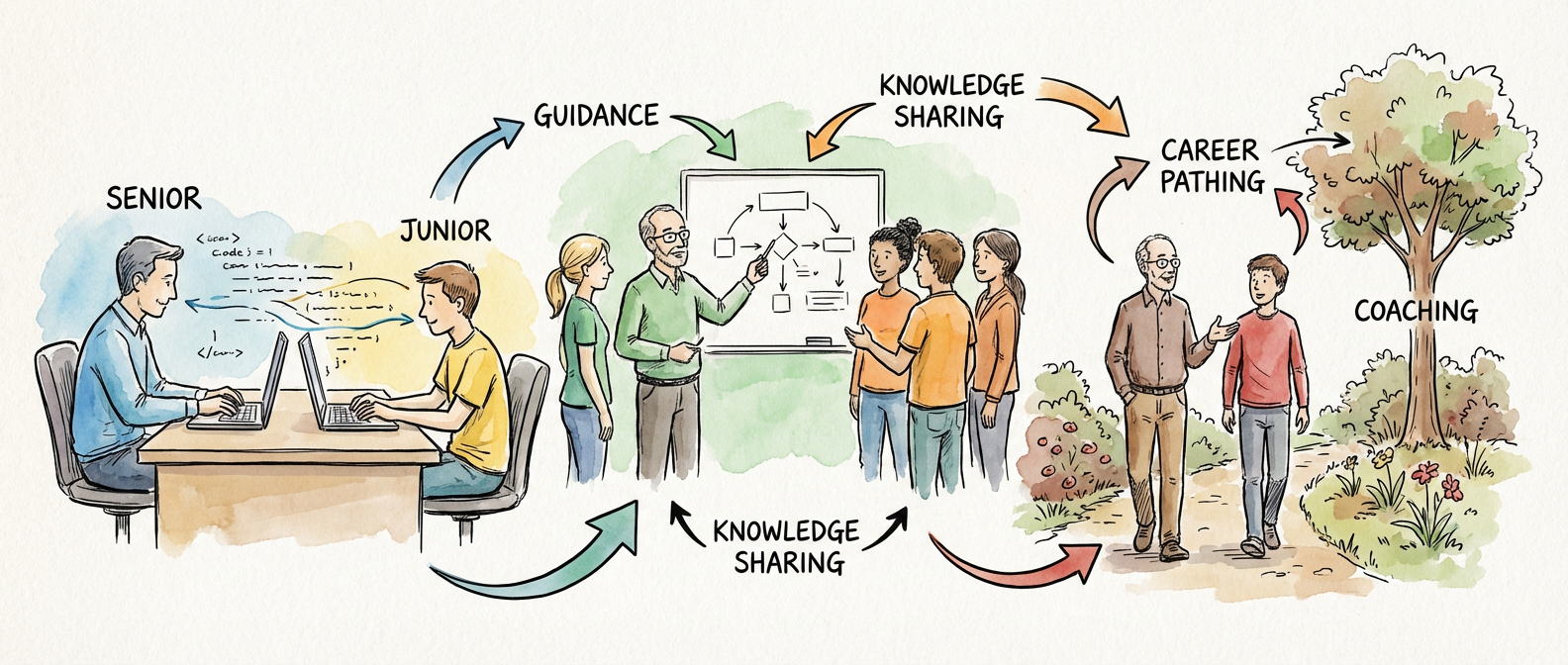
The best mentorship relationships I’ve observed work like well-designed APIs. There’s a clear contract, predictable interfaces, and graceful error handling. The mentor provides consistent, reliable guidance while the mentee learns to make increasingly complex requests. Both parties understand the boundaries, expectations, and failure modes. This isn’t about being warm and fuzzy. It’s about being effective.
I’ve seen too many mentorship programs fail because they treat the relationship as purely interpersonal rather than as an engineering problem that requires intentional design. The most successful mentors I know approach the relationship with the same rigor they bring to system architecture. They define success criteria, establish feedback loops, and iterate based on outcomes.

The Pairing Protocol: How Knowledge Actually Transfers
Real knowledge transfer happens in the details, not in the abstractions. When I mentor engineers, I spend most of our time looking at actual code, reviewing real design decisions, and walking through specific problems they’re facing. The magic happens when we’re both staring at the same terminal, debugging a race condition or optimizing a query that’s killing the database.
I’ve developed what I call the “three-layer explanation” approach. First, I solve the immediate problem with them. We get the build green, the service responding, or the deployment working. Second, I explain the underlying principles that make the solution work. Why this algorithm, why this data structure, why this architectural pattern. Third, we discuss how this specific solution fits into the broader system design and what trade-offs we’re accepting.
The key insight here is that context switching is expensive for learning, just like it is for processors. When an engineer is stuck on a specific problem, that’s the perfect time to layer in deeper understanding. Their brain is already loaded with the relevant context. They’re motivated to understand because they need to solve the immediate issue. This is when abstract principles become concrete knowledge.
The Feedback Loop: Measuring Progress Without Micromanaging
One of the hardest parts of mentorship is knowing when your mentee is ready for more autonomy and when they still need guidance. I’ve learned to think about this in terms of observability. Just like monitoring a production system, you need the right metrics and alerts to understand what’s actually happening.
I track several leading indicators: the quality of questions they’re asking, how they approach problem decomposition, and their ability to reason about system trade-offs. When someone starts asking “What happens if we get a million concurrent users?” instead of “How do I fix this bug?”, that’s a signal they’re thinking at the right level of abstraction. When they can explain why they chose one approach over another, they’re moving from following patterns to understanding principles.
Most mentors either hover too closely or disappear entirely. The right approach is more like building a monitoring dashboard. You set up the instruments to track progress, establish thresholds for when intervention is needed, and then trust the system to work. You’re available for escalation, but you’re not constantly polling for status.
Code reviews become particularly valuable here. They’re not just about catching bugs or enforcing style guidelines. They’re your primary feedback mechanism for understanding how your mentee thinks about problems, what patterns they’re learning, and where they need help.
The Scale-Out Strategy: Building Multiplier Effects
The most effective senior engineers I know don’t just mentor individuals. They build systems that amplify their impact across entire teams and organizations. This means documenting not just what to do, but why certain approaches work and others don’t. It means creating runbooks that capture decision-making processes, not just procedural steps.
I’ve found that the best mentorship artifacts are those that survive the relationship itself. Design documents that explain the reasoning behind architectural choices. Code comments that describe not just what the code does, but why it was written that way. Post-mortem documents that capture not just what went wrong, but what mental models led to the failure.
This approach requires thinking about knowledge as a shared resource that needs to be managed and maintained. Just like technical debt, knowledge debt accumulates over time. Undocumented assumptions become single points of failure. Tribal knowledge creates bus factor problems. Senior engineers who have the most impact treat knowledge sharing as a core engineering responsibility, not an occasional favor.
The Long Game: Developing Technical Judgment
The hardest thing to teach, and the most valuable thing a mentor can provide, is technical judgment. This is the ability to make good decisions under uncertainty, to balance competing trade-offs, and to know when to break the rules you’ve been taught. Technical judgment can’t be transmitted through documentation or lectures. It develops through repeated exposure to decision-making processes and their long-term consequences.
I’ve learned to be very explicit about the reasoning behind my decisions, especially when they might seem counterintuitive. When I choose a simpler solution over a more elegant one, I explain that we’re optimizing for maintainability over performance because our traffic patterns don’t justify the complexity. When I decide to take on technical debt to meet a deadline, I explain exactly what we’re trading off and how we’ll pay it down later.
The goal isn’t to create mini-versions of myself. It’s to help engineers develop their own judgment frameworks. They need to understand not just my solutions, but how I arrived at them. What information I considered, what constraints I was working within, and what assumptions I was making about the future.
The engineers who’ve benefited most from my mentorship are those who eventually started challenging my decisions and proposing better alternatives. That’s when you know the relationship has succeeded. They’ve learned the principles well enough to apply them in new contexts and extend them in ways you hadn’t considered.
If you’re a senior engineer reading this and recognizing patterns from your own experience, I’d be curious to hear what approaches have worked for you. The best mentorship strategies I know have emerged from practitioners sharing what they’ve learned in the trenches, not from theoretical frameworks. What techniques have you found effective for transferring not just knowledge, but judgment?