The Pricing Signal That Changed Everything
I’ve been running production workloads on AWS Lambda since 2017, back when cold starts felt magical and the promise of infinite scale without infrastructure management seemed too good to be true. That honeymoon period officially ended this January when AWS quietly updated their AWS Lambda pricing updates, hiking costs by 23% for functions requiring more than 15GB of memory while simultaneously dropping ECS Fargate Spot pricing by 31%.
The message was crystal clear. AWS was pushing customers toward containers, and the economics suddenly made that migration not just viable but necessary for any team running memory-intensive workloads. I watched our monthly Lambda bill jump from $14,000 to just over $17,000 for the same workload that had been running unchanged for eight months. That’s when I knew we had a problem.
What followed was six months of careful analysis, migration planning, and honest conversations about what serverless actually means in 2026. The conclusions weren’t what I expected when I started this journey. They’re forcing me to reconsider assumptions I’ve held for nearly a decade.
Performance Degradation and the Cold Start Tax
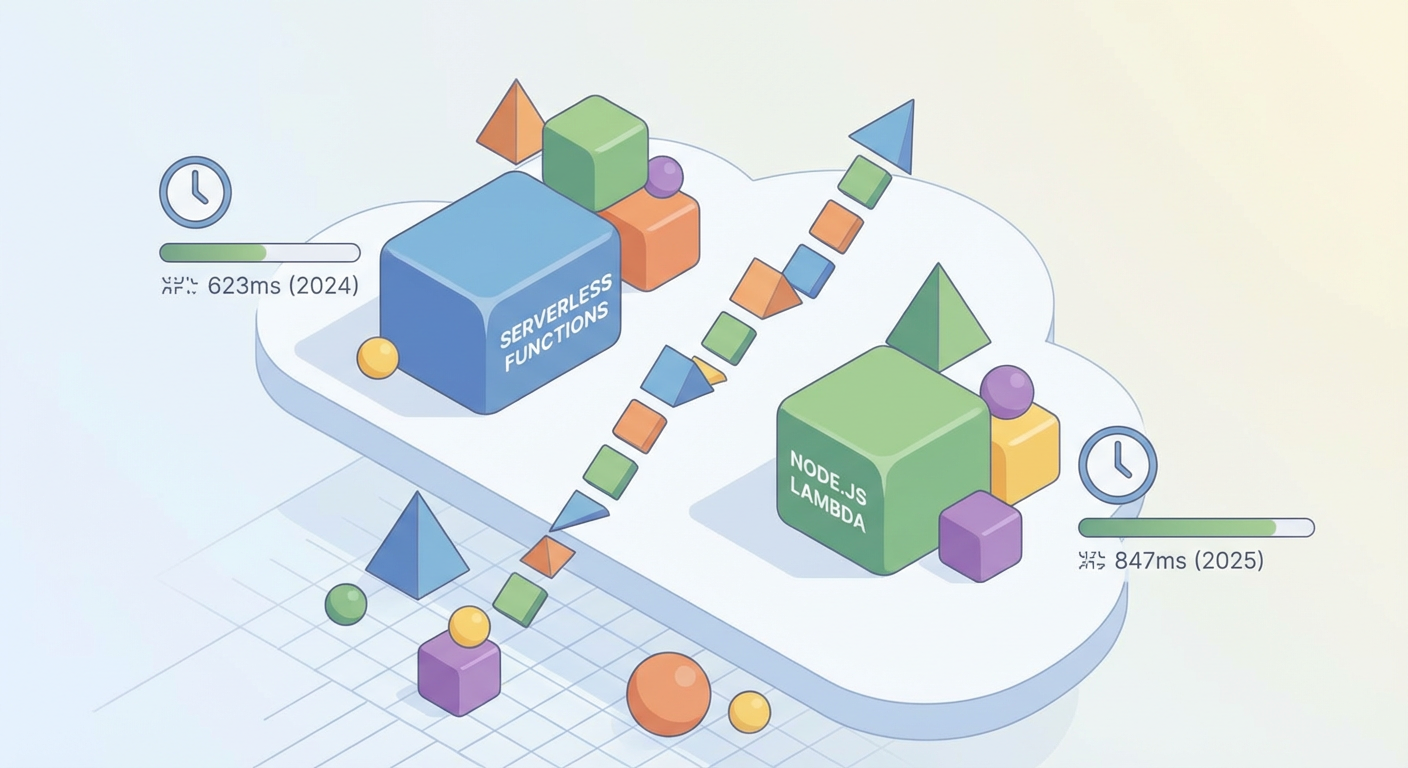
The pricing changes weren’t happening alone. Throughout 2025, I noticed our Lambda functions getting sluggish. What used to be snappy 400ms response times for our Node.js microservices gradually crept up to 600ms, then 700ms, then worse. The latest Datadog serverless report confirmed what many of us were experiencing: average cold start times for Node.js functions hit 847ms in 2025, up from 623ms just a year earlier.
Cold starts have always been the Achilles heel of FaaS platforms, but this level of degradation suggested something fundamental had changed. Whether it’s increased infrastructure density, security scanning overhead, or simply the weight of accumulated technical debt in AWS’s Lambda runtime, the performance characteristics that made serverless attractive for user-facing applications were eroding.
We started tracking detailed metrics on cold start frequency and duration across our function portfolio. The results were sobering. Functions that handled fewer than 100 requests per hour were spending nearly 40% of their execution time in cold start overhead. For batch processing jobs that ran sporadically, this wasn’t catastrophic. For API endpoints serving customer traffic, it was becoming untenable.
The Netflix Exodus and Industry Validation
When Netflix announced they had migrated 40% of their Lambda functions to ECS Fargate between September 2025 and February 2026, saving $2.1 million annually, it validated what many of us were already thinking. If a company with Netflix’s engineering sophistication and AWS partnership was making this move, the economics had fundamentally shifted.
I spent considerable time analyzing their published migration patterns and cost breakdowns. The savings weren’t just from the raw compute pricing differences. They were realizing efficiency gains from better resource utilization, eliminated cold start taxes, and more predictable performance characteristics. Their long-running media processing workloads, in particular, were seeing 60% cost reductions when moved from Lambda to Fargate Spot instances.
Google Cloud Run’s 156% enterprise adoption growth during Q4 2025 tells the other half of this story. Teams weren’t just moving away from Lambda. They were questioning whether AWS was still the best platform for their containerized workloads. Cloud Run’s more predictable pricing model and consistently faster cold starts made it an attractive alternative for teams willing to embrace multi-cloud strategies.
Kubernetes and the Redefinition of Serverless
The most interesting development has been watching how the industry defines “serverless” in 2026. The CNCF Annual Survey 2025 revealed that 68% of organizations now run serverless workloads on Kubernetes rather than traditional FaaS platforms. This isn’t just semantic evolution. It represents a fundamental shift in how we think about operations abstraction.
I’ve been experimenting with Knative on our internal Kubernetes clusters, and the developer experience is remarkably close to Lambda for many use cases. Auto-scaling from zero, request-driven scaling, and pay-per-use billing models are all achievable with container-native approaches. The operational overhead is higher, certainly, but for teams already running Kubernetes infrastructure, the extra complexity is manageable.
What’s particularly compelling about the Kubernetes-based serverless approach is the elimination of vendor lock-in. Functions written for Knative can run on any Kubernetes cluster, whether that’s on-premises, AWS EKS, Google GKE, or Azure AKS. For organizations concerned about cloud concentration risk, this portability is increasingly valuable.
Practical Migration Strategies and Lessons Learned
Our migration from Lambda to a hybrid container-first architecture took four months and taught me several important lessons. The first is that not all Lambda functions are created equal. Simple, stateless HTTP handlers translated beautifully to containers running on Fargate. Complex functions with complex IAM permission models and extensive AWS service integrations required more careful consideration.
We developed a decision matrix based on execution frequency, memory requirements, cold start sensitivity, and AWS service dependencies. Functions running more than once per minute with memory requirements above 3GB became immediate candidates for containerization. Infrequently executed functions with minimal memory footprints stayed on Lambda, where the pricing model still made sense.
The most significant architectural change was moving from a purely event-driven model to a hybrid approach. Instead of having dozens of small Lambda functions triggered by SQS messages, we consolidated related functionality into longer-running services that poll queues directly. This reduced cold start frequency while maintaining the loose coupling we valued in our serverless architecture.
Monitoring and observability required retooling as well. AWS X-Ray’s automatic tracing for Lambda functions had spoiled us. Implementing equivalent observability for containerized workloads required deliberate instrumentation and more sophisticated monitoring stack configuration. The operational burden increased, but we gained much more granular control over our telemetry data.
The truth about serverless in 2026 is messier than the binary choice between FaaS and traditional infrastructure management. The real value lies in understanding which abstraction level works best for your specific use case. Sometimes that’s Lambda, sometimes it’s containers, and increasingly often it’s a thoughtful combination of both. If you’re facing similar decisions in your architecture, I’d be curious to hear about your experiences and the factors driving your technology choices.